Beluga whale
The WhaleThe Beluga whale is presented as a strikingly adaptable Arctic cetacean whose life is repeatedly constrained by human efforts to capture, display, hunt, or employ it. The book moves between a close encounter with a captive animal, nineteenth-century accounts of belugas transported across continents, and reports of hunting and military use. Together, these episodes make the whale more than a symbol of human feeling: they record specific lives shaped by the conditions people impose on them.
Appearance and presence
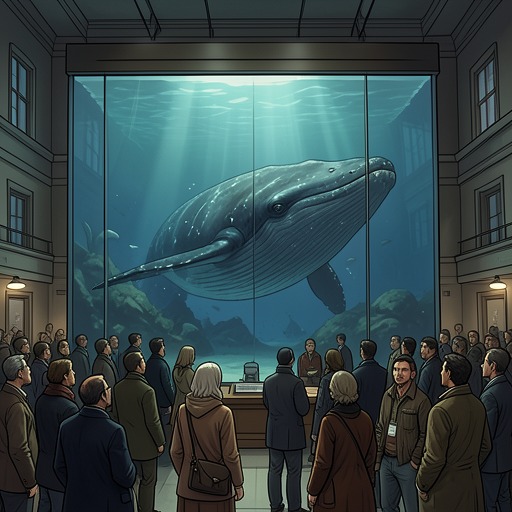
In a Coney Island aquarium, a Beluga whale appeared behind a thick observation window, rising vertically as if to meet the visitor’s gaze. The animal was estimated at twelve feet from its rounded head to its short flukes. Its pale body and direct stare made it seem at once immense and vulnerable, a presence that unsettled the narrator in the otherwise empty aquarium. The glass permitted a close view but kept the animal inaccessible; the narrator touched the pane and waited for a response that did not come.
The encounter depends on a contrast between the Beluga’s aquatic life and its urban enclosure. The narrator imagines the animal belonging in Arctic waters, not in a city tank. Its species is described elsewhere as highly vocal, earning from sailors the name canary of the sea. In the aquarium, however, the stillness and quiet made that reputation poignant: the whale was separated from the environment and activity associated with its life. The scene does not establish what the animal perceived, but it makes the limits of human access plain. Looking through glass is not the same as sharing the whale’s world.
Captured for public display
The Coney Island Beluga had a nineteenth-century precedent. In 1861, Phineas T. Barnum brought two belugas from waters off Labrador to his American Museum in New York. The animals, twenty-three and eighteen feet long, were placed in a basement tank measuring fifty-eight by twenty-five feet and less than seven feet deep. The tank held fresh water. Reports described the pair swimming together, while even Barnum anticipated that their lives in captivity would be brief. They died within days, and successive animals replaced them until a fire destroyed the museum in 1865. During the fire, a fireman broke the tank in an effort to release the last Beluga; the whale nevertheless died in the blaze.
A later capture followed an even longer route. In September 1877, a nine-foot-six-inch Beluga was caught off Labrador with ten others after the animals stranded at high tide. It travelled by sloop in a narrow box to Montreal, then by train to New York, a journey taking two weeks. The whale spent seven months in the Summer Aquarium at Coney Island, where it developed a habit of swimming in circles. It was then removed from its tank and carried aboard the steamship Oder, bound for Southampton. During the Atlantic crossing it was kept on deck in a wooden box lined with seaweed and regularly wetted with salt water. Despite this care, it began to live off its own blubber.
At Southampton, the whale continued by rail on an open truck to Waterloo Station and its final destination, the Royal Aquarium, Westminster. Its iron tank measured forty-four feet long, twenty feet wide, and six feet deep. The whale was transferred into the water after lying still in its box; after three hours without visitors, it was shown to a large public crowd. The Times questioned the conditions, noting the freshwater tank, the noise around the animal, and its increasingly prominent dorsal ridge. The whale was fed live eels, but these provisions did not offset the strains of its confinement and journey.
Death and public argument
The Beluga, later identified as female, swam rapidly along the tank and collided with its walls before dying. Its death did not end its public display: the body was exhibited the next day, a plaster cast was made, and naturalists and physicians conducted a necropsy. They found a full stomach, but also severely congested lungs. The account attributes the illness to the whale’s exposure on deck during the crossing: repeated wetting was followed by rapid evaporation, which caused it to catch cold. The concrete cause complicates any impression that careful attention during transport could make the journey safe.
The death prompted disagreement over whether the exhibition had been justified. Bishop Claughton objected that the whale had been removed from the element in which it belonged. William Flower, who attended the examination and later became the first director of the Natural History Museum, London, defended the undertaking on the grounds of scientific and general knowledge. His institution also received the whale’s internal organs for preservation and study. The debate thus joined public curiosity, scientific collecting, and concern for the animal, without resolving the conflict between learning about a living whale and keeping one captive.
The book links this episode to Barnum’s earlier exhibits and, much later, to the public response to a whale that died in the Thames. In the later case, an illustration of the animal laid out for public attention recalled the Westminster Beluga, another whale displayed after death and misidentified as to sex. The recurrence turns the aquarium story into part of a longer history: the whale becomes an object of mass attention in life and in death, while public emotion and scientific use persist alongside the conditions that caused its suffering.
Hunting and entrapment in northern waters
Belugas also appear not as imported attractions but as animals hunted in their northern range. By the middle of the twentieth century, Canada had imposed licences for hunting them, while allowing Indigenous peoples and the Royal Canadian Mounted Police to kill them for domestic use and to feed dogs. The book reports that thousands of Belugas and narwhals continued to be hunted each year, from small boats or from the ice. These accounts distinguish regulation from protection: licensing limited who could hunt, but did not remove the pressure on the animals.
Winter adds another danger. When inlets freeze, Belugas swimming into them may find the ice too extensive to cross in a single breath. At Point Barrow, Alaska, nine hundred Belugas were trapped around an opening in the ice measuring one hundred and fifty yards by fifty. They surfaced every twelve to eighteen minutes, taking ten or fifteen breaths before diving again. Their tendency to surface together intensified the danger: animals crowded one another in the confined opening, and three hundred were taken in a single day. The episode shows how a social pattern that belongs to the animals’ lives can become a vulnerability when the surrounding environment closes in.
Use and significance
The book also records the enlistment of Belugas in military work. From the 1960s, the United States Navy’s Marine Mammal Program trained Belugas as well as bottlenose dolphins to identify mines and serve as underwater sentries. The account distinguishes those documented tasks from rumors that dolphins in Vietnam had been trained to kill divers. It also notes the use of dolphins to clear mines during the Gulf War. For Belugas, the stated role is detection and sentry work, but the larger pattern is the conversion of cetacean capacities into military tools.
Across aquariums, hunting grounds, frozen inlets, and military programs, the Beluga’s encounters with humans are shaped by competing claims of usefulness: spectacle, scientific knowledge, food, and strategic labor. Yet the repeated failures of captivity, the hazards of transport, and the scale of hunting keep the animal’s own life at the center of the account. The Beluga is not simply an image through which people debate compassion or progress. Its need for an aquatic environment, its vocal character, and its exposure to human decisions mark the limits of a human world that can observe, classify, and use the whale without thereby understanding or accommodating it.